POC Helmets Canada: Which One Is Right for You?
Why POC helmets stand apart
POC is a Swedish brand that has built its reputation on one principle: fewer serious injuries in sport. Founded in 2005, the brand entered cycling with the same engineering philosophy it applied to ski racing - test everything, comply with nothing less than the highest safety standards, and design products that riders at the top of the sport will actually wear. The result is a helmet lineup that is consistently among the most protection-focused in cycling, without sacrificing aerodynamics, ventilation, or fit quality.
For Canadian cyclists, POC helmets offer another advantage: they are built for real conditions. The brand prioritizes extended coverage, visor and eyewear integration, and durability through multi-season use. Whether you are riding road in Ontario, trail riding in British Columbia, or commuting through a Toronto winter, there is a POC helmet designed for your use case.
This guide covers every POC helmet model available at Chain Reaction Bicycles, explaining what makes each one different and which type of rider it is built for.
Understanding POC safety technology: MIPS vs SPIN
Before comparing specific models, it helps to understand the two safety technologies POC uses across their helmet lineup. Both address rotational forces in a crash - a major cause of brain injury that standard safety ratings do not measure.
What is MIPS?
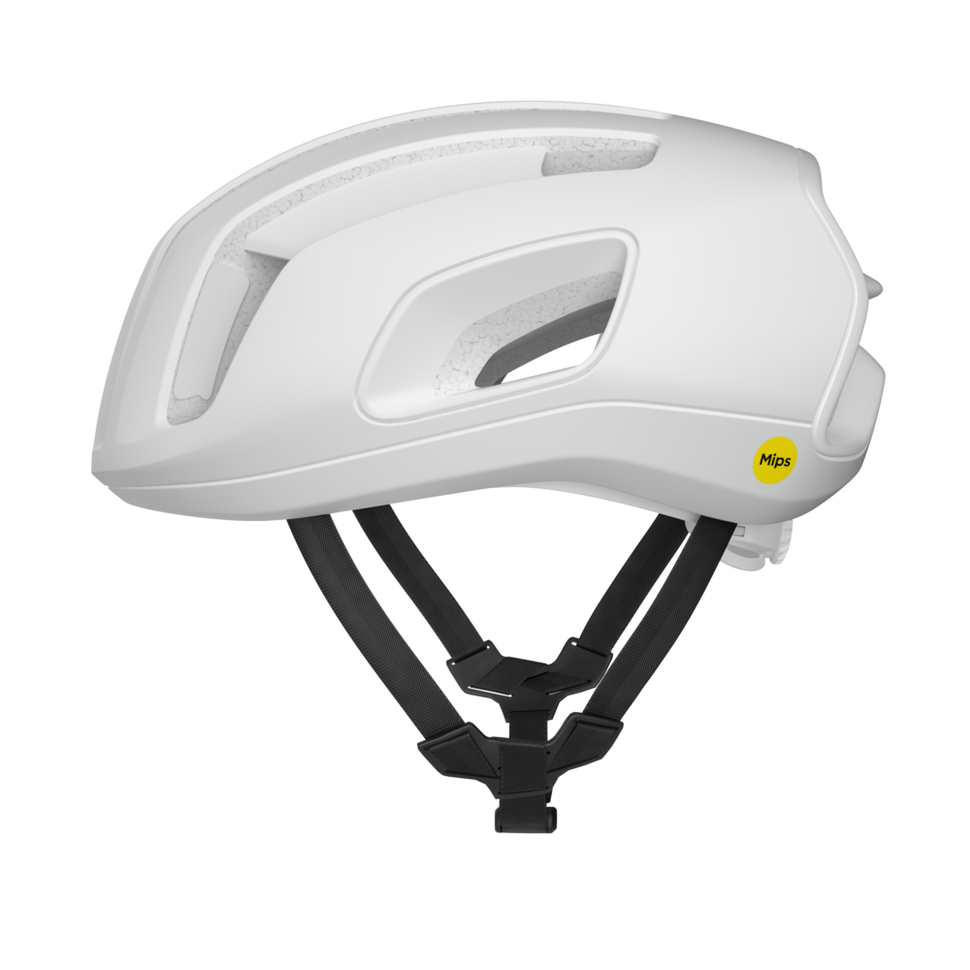
MIPS (Multi-directional Impact Protection System) is a separate low-friction liner inside the helmet that moves independently of the outer shell during an impact. When a helmet strikes a surface at an angle (as most crashes do), the MIPS liner rotates slightly, absorbing rotational energy before it reaches your brain. MIPS is an industry standard technology licensed to dozens of helmet brands and is independently validated through external testing.
MIPS certification adds meaningful rotational impact protection with minimal impact on helmet weight, ventilation, or fit. POC includes MIPS in several of their road and versatile helmets.
What is SPIN?
SPIN (Shearing Pad INside) is POC's proprietary rotational protection technology. Instead of a separate liner, SPIN uses silicone pads placed at strategic locations inside the helmet that shear (slide) under oblique impact loads, absorbing rotational energy similarly to MIPS but through a different mechanism. POC uses SPIN in their mountain bike helmets, where SPIN's placement and integration suit the extended coverage and construction of trail-oriented designs.
Both MIPS and SPIN address the same fundamental safety problem. The choice between them is determined by the helmet design, not by one technology being categorically superior to the other. All POC helmets with rotational protection - whether MIPS or SPIN - meet the same underlying safety goal.
POC road helmets at Chain Reaction Bicycles
POC Omne Air MIPS - best all-around versatile road helmet
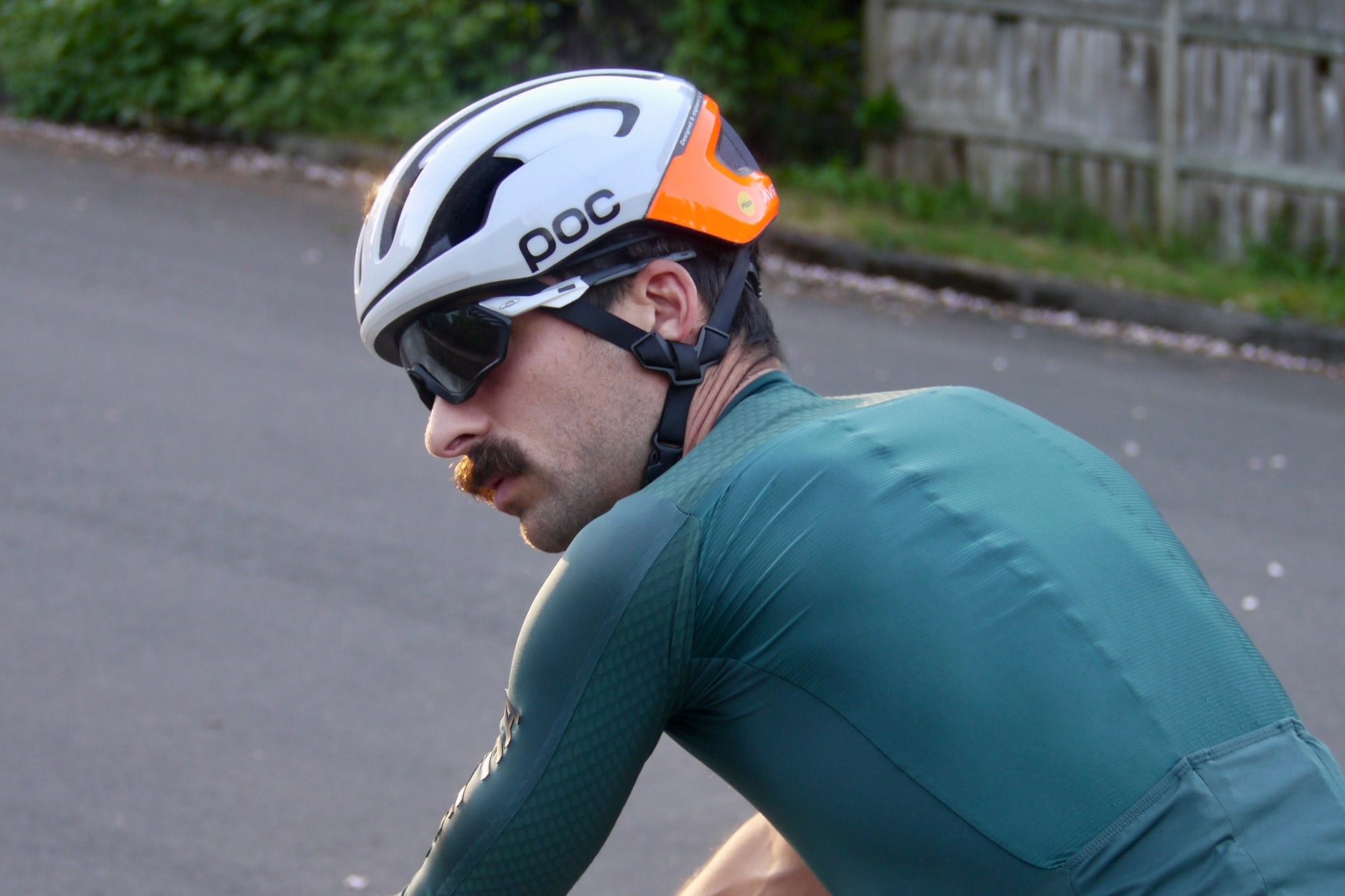
The POC Omne Air MIPS is POC's most versatile road helmet and one of their best sellers. It uses a rounded shell that provides better coverage than most road helmets without adding bulk, and the MIPS liner addresses rotational forces in a crash. The ventilation is comfortable for road and commuting use - not a high-performance race ventilation system, but excellent for all-day wearability in a range of conditions.
The Omne Air fits a wide range of head shapes and works with most cycling sunglasses and eyewear. It is a strong first choice for riders who want proven safety credentials, everyday wearability, and a clean look that suits both road riding and urban cycling.
Best for: road cyclists, commuters, and riders who want one helmet that does everything well.
Price: $249.99
POC Amidal - best dedicated road helmet
The POC Amidal is built specifically for road riding, with an elongated form, large ventilation channels, and a lightweight construction focused on comfort during long days in the saddle. Where the Omne Air prioritizes all-around versatility, the Amidal is optimized for road cycling: better ventilation on long climbs, a more secure fit system for fast descents, and a shape that integrates cleanly with road cycling eyewear.
The Amidal does not use MIPS or SPIN, but meets EN1078 and CPSC safety standards. It is a strong choice for riders who prioritize ventilation and weight on road-specific rides and are comfortable with standard (non-rotational) impact protection at this price point.
Best for: dedicated road cyclists who prioritize ventilation and comfort on long rides.
Price: $299.00
POC Cytal - best aero road helmet
The POC Cytal brings aerodynamic design to the POC road lineup. It uses a smoother outer shell with optimized airflow channels that reduce drag compared to conventional ventilated road helmets - measurable in time trials, triathlons, and fast road events. The Cytal retains meaningful ventilation for general riding while offering an aerodynamic advantage when speed matters most.
For riders who do mixed training (both general road riding and faster events), the Cytal sits between a pure aero helmet and a pure ventilation-focused design. It is a thoughtful choice for competitive road cyclists who want to use the same helmet across training and racing.
Best for: competitive road cyclists and triathletes who want aerodynamic performance for events without sacrificing day-to-day wearability.
Price: $399.99
POC Cytal Lite - best premium aero road helmet
The POC Cytal Lite is the top of the POC road lineup: a premium aero helmet built for riders who want the best combination of aerodynamic performance, light weight, and POC's characteristic extended coverage and protection design. It reduces weight and refines the aerodynamic profile of the standard Cytal while maintaining the fit and comfort that POC road helmets are known for.
At this price point, the Cytal Lite is a statement purchase for serious road cyclists. It is the helmet choice for riders who want the most refined POC road offering available.
Best for: serious competitive road cyclists who want a premium aero helmet with POC's safety engineering.
Price: $479.99
POC mountain bike helmets at Chain Reaction Bicycles
POC Tectal Race SPIN - best trail and enduro MTB helmet
The POC Tectal Race SPIN is designed for trail and enduro riding where extended coverage matters. It uses SPIN technology for rotational impact protection and provides more head coverage than a road helmet - including extended rear coverage and reinforced zones at the most common impact points in mountain bike crashes. The fit is secure enough for aggressive trail riding without feeling restrictive on the climb.
The Tectal Race SPIN is compatible with POC eyewear and integrates well with trail riding goggles. It is a serious trail helmet built for riders who ride challenging terrain and want proven rotational protection without the full-face restriction of a downhill lid.
Best for: trail riders, enduro riders, and mountain bikers who want extended coverage and rotational impact protection for technical terrain.
Price: $189.99
POC Kortal Race MIPS - best cross-country and trail MTB helmet
The POC Kortal Race MIPS is a high-performance mountain bike helmet that bridges cross-country and trail riding. It uses MIPS for rotational protection and focuses on ventilation and light weight - the priorities for XC riders who spend a lot of time climbing. The coverage is still meaningfully more than a road helmet, with an extended rear shell that protects the back of the head, but the ventilation and weight are closer to a road helmet than a full trail lid.
The Kortal Race MIPS is the right choice for mountain bikers who prioritize speed and climbing efficiency but still want meaningful protection for occasional trail descending. It is also well suited to gravel riders who spend time on technical terrain and want MTB-level coverage with road-oriented weight.
Best for: cross-country mountain bikers, gravel riders on technical terrain, and trail riders who prioritize light weight and ventilation.
Price: $279.99
POC entry-level and versatile helmets
POC Crane MIPS - best entry-level POC helmet
The POC Crane MIPS is POC's most accessible helmet and an excellent entry point into the brand. It uses MIPS for rotational protection, offers meaningful coverage beyond standard entry-level road helmets, and fits the wide head shapes that POC designs for. The Crane MIPS is the right choice for riders who want POC's safety approach without the price commitment of the road or trail-specific lineup.
The Crane suits road riding, commuting, and casual trail use. It is a practical all-purpose helmet that delivers real safety value at an accessible price point.
Best for: new cyclists, commuters, and riders who want POC quality and MIPS protection at an accessible price.
Price: $79.99
How to choose the right POC helmet for your riding
Use these criteria to narrow down the right model:
Are you primarily a road cyclist? Start with the Omne Air MIPS for versatility, the Amidal for dedicated road focus, or the Cytal if you prioritize aerodynamic performance.
Are you a mountain biker? If you ride cross-country or prioritize light weight, the Kortal Race MIPS is the right choice. If you ride trail or enduro and want extended coverage, go with the Tectal Race SPIN.
Are you a commuter or new cyclist? The Crane MIPS delivers MIPS protection and POC build quality at a price point accessible for all riders.
Do you want the best POC has to offer for road? The Cytal Lite is POC's premium road helmet: maximum aerodynamic performance with the safety engineering and fit quality the brand is known for.
POC helmet fit: what to know before you buy
POC helmets are designed around a rounded head shape that is somewhat broader than the average European helmet brand. If you have struggled to find helmets that fit comfortably from other brands, POC is often a better match. However, head shape varies significantly between riders, and the only reliable way to confirm fit is to try the helmet in person.
Key fit checks for any cycling helmet:
- Level placement: The front of the helmet should sit approximately two finger widths above your eyebrows. Too high exposes your forehead. Too low restricts vision.
- Snug without pressure: The helmet should feel secure when you shake your head, without creating pressure points that cause discomfort over time.
- Chin strap position: The straps should form a V-shape below each ear, with the buckle positioned under your chin. You should be able to fit two fingers between the strap and your chin.
- Fit system: All POC helmets use a retention dial at the back of the helmet that allows micro-adjustment to ring size. Dial in until the helmet is snug with no movement, but no pressure on your occipital bone.
Visit Chain Reaction Bicycles in Toronto to try POC helmets in person and confirm fit before purchasing.
When to replace your cycling helmet
A helmet should be replaced after any crash in which it absorbs an impact, even if no damage is visible. The foam liner compresses on impact and does not return to its original protective capacity. This is true for all helmet brands, including POC.
Outside of crashes, most helmet manufacturers recommend replacing helmets every 3-5 years under regular use. UV exposure, sweat, and general wear degrade the foam and shell over time, reducing protective capacity. If your helmet is showing visible cracks, degraded foam, or a fit system that no longer functions correctly, replace it regardless of age.
POC helmets and other protective gear
If you are investing in a POC helmet, consider completing your protective setup with compatible eyewear and other gear. POC designs their helmets and eyewear to integrate well together - their sunglasses and goggles are specifically shaped to work with the ventilation channels and coverage of POC helmet designs.
For road cyclists building out their kit alongside a new helmet, see our selection of road bikes and road shoes. For mountain bikers, browse mountain bikes and mountain bike shoes.
FAQs: POC helmets Canada
Are POC helmets worth the price?
POC helmets consistently rank among the highest-performing helmets in independent safety testing, including Virginia Tech helmet ratings where several POC models receive 5-star ratings. The price reflects genuine engineering investment in protection, ventilation, and fit quality. If head protection is a priority, POC is a defensible choice at every price point they offer.
What is the difference between MIPS and SPIN in POC helmets?
Both MIPS and SPIN address rotational impact forces - a major cause of brain injury in crashes. MIPS uses a separate low-friction liner that rotates independently of the shell. SPIN uses integrated silicone pads that shear under oblique impacts. POC uses MIPS in road and versatile helmets and SPIN in mountain bike helmets. Both deliver comparable rotational protection through different mechanisms.
Do POC helmets fit wide heads?
POC helmets are generally designed with a rounder, wider shell shape than many European helmet brands. Riders who find other brands too narrow often find POC a significantly better fit. However, head shape varies, and trying on in person is always the most reliable method.
Which POC helmet is best for road cycling in Canada?
For most road cyclists in Canada, the POC Omne Air MIPS is the strongest all-around choice: MIPS protection, excellent ventilation, good coverage, and everyday wearability. For aerodynamic performance, the Cytal or Cytal Lite is the step up.
Which POC helmet is best for mountain biking?
For trail and enduro, the Tectal Race SPIN is the better choice - more coverage, SPIN protection, trail-oriented design. For cross-country and gravel, the Kortal Race MIPS prioritizes light weight and ventilation while still providing meaningful coverage.
Shop POC helmets at Chain Reaction Bicycles
Browse the full POC helmet collection at Chain Reaction Bicycles, or explore all road helmets and mountain bike helmets to compare POC against other brands. All helmets are in stock and available for same-day pickup at our Toronto location.
Recent articles
View all
How to Set Up Tubeless MTB Tires: A Complete Guide for 29 Inch Wheels
29 vs 27.5 Mountain Bike Tires: Which Wheel Size Is Right for You?